Safe on site. Understood on the job. Ready for the exam.
Language training for the skilled workforce in crafts and construction. The Langenscheidt Language Coach trains operatives in site-safety vocabulary, in the phrasing they'll actually use with customers, and in exam language for the German journeyman and master-craftsman qualifications — mobile on site, visible in HR and safety reporting. Available in German and English.
You've hired the skilled hands. But do they understand the safety briefing? And the customer?
In general construction, fit-out and customer-facing trades, 25–40% of skilled operatives are international workers today. They bring craft skills — but the German for Toolbox Talks, customer conversations and master-craftsman exams isn't basic language. It's specific technical vocabulary that doesn't appear in traditional language courses.
The consequences are measurable: safety briefings run longer or shallower — but in a BG BAU incident review, what counts is documented proof they were understood. Customer requests are only partially captured — the variation gets lost, the complaint arrives. Master-craftsman candidates fail on the language even though they know the trade inside out — and the business loses its next generation of qualified staff.
Language in crafts and construction isn't a training-and-development topic — it's a safety factor, a revenue factor, and an exam factor. Build it systematically and you reduce three operational risks at once.
Language as a business factor.
Three pillars that make the difference between a "language course" and "workplace German ready for site, customer and exam".
Safety language — Toolbox Talks and site briefings
Operatives practise safety vocabulary and the standard phrasing of Toolbox Talk briefings — with Elva, our AI trainer. Briefings on site then run faster and are demonstrably understood. Upload your site-specific method statements and risk assessments to include them.
Customer language — scoping and variations
Trade-specific vocabulary for customer conversations: appointment confirmation, scoping the job, flagging a variation, discussing price, handling a complaint. Role-plays with Elva for typical scenes at the customer's door. Feedback on pronunciation, phrasing and tone — with direct impact on variation revenue and complaint rates.
Exam language — journeyman and master-craftsman
Exam prep aligned with the German Handwerksordnung (the trades law governing qualifications): theoretical parts of the journeyman exam, all four parts of the master-craftsman exam — practice, theory, business/law, teaching methodology. Trade-specific vocabulary, standard phrasing for the oral exam, comprehension of the written parts. Keep your next generation of qualified staff instead of losing them at the language barrier.
Toolbox Talk on scaffold safety
Scene: an operative, native Romanian speaker, practises with Elva ahead of the weekly Toolbox Talk — vocabulary for fall protection and anchor points on a cantilever scaffold.
Elva: "Where do you inspect the anchor point for your fall-arrest PPE?"
Operative: "At the marked ring at the fall edge, visually checked before every use."
Elva: ✓ Clear structure. Position, height, inspection step — all in. Quick tip: also add "and sign off in the briefing log" — that's the BG-BAU-compliant follow-through.
Elva: "Next question: what do you do if you spot damage on a cantilever bracket?"
Operative: "I report it to the foreman immediately, the scaffold is closed off until the scaffolder releases it. No access in that area."
Elva: ✓ Excellent. The point "scaffold closed off until the scaffolder releases it" is the critical one. You're ready for Monday's Toolbox Talk.
The Language Coach in the daily flow of site and customer.
Three typical situations — Monday morning site handover, customer conversation on a bathroom renovation, and Toolbox Talk before shift start.

Fifteen minutes of briefing. A clean start to the week.
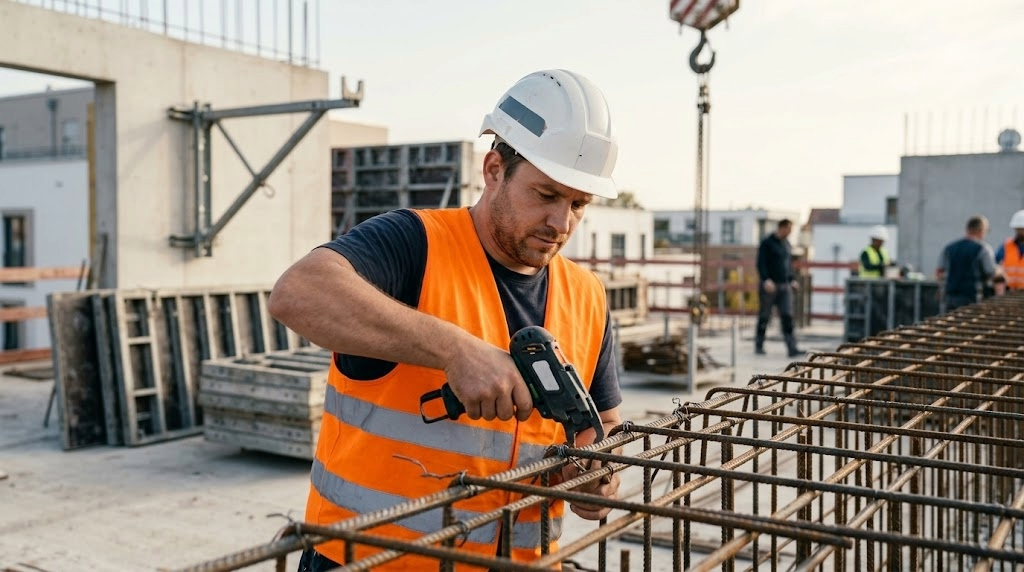
An operative, native Polish speaker, joins the Monday morning start on a shell-construction site. The foreman covers priorities, safety points and the material order for Tuesday's concrete pour. With Elva he practised targeted shell-construction German in the weeks before — rebar, formwork, anchor, fall protection. The handover runs cleanly in twelve minutes, the week starts without a hitch.
Operative: "Got it — rebar east gable. What cut length are we working with?"
Foreman: "12mm, two-twenty. Crane at half-past-eight."
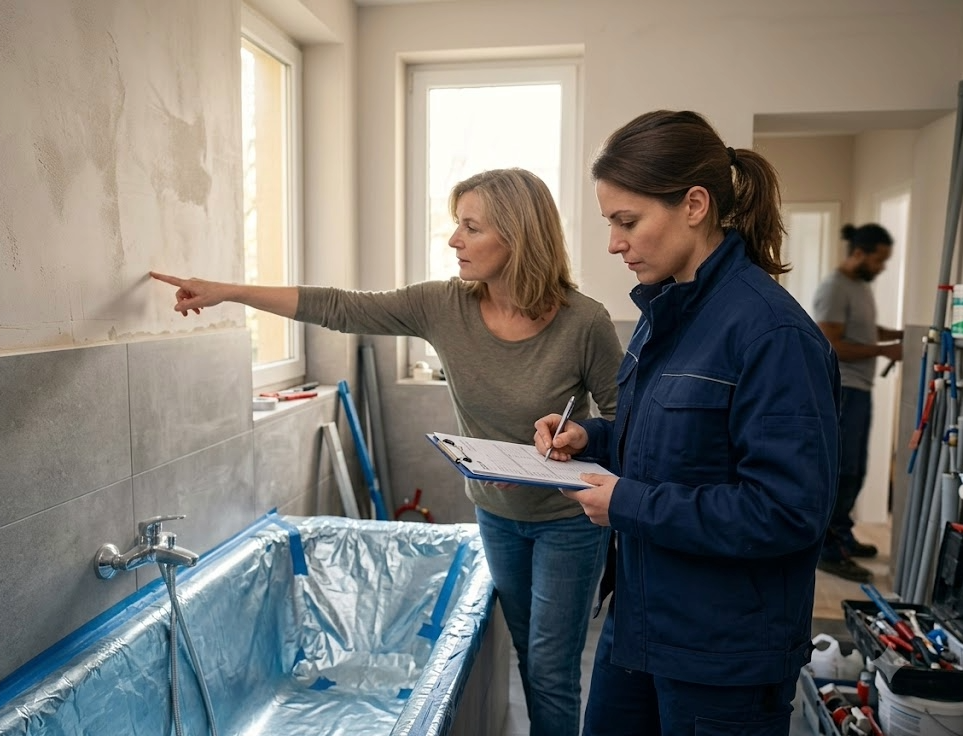
The customer's request. Cleanly captured, cleanly flagged.
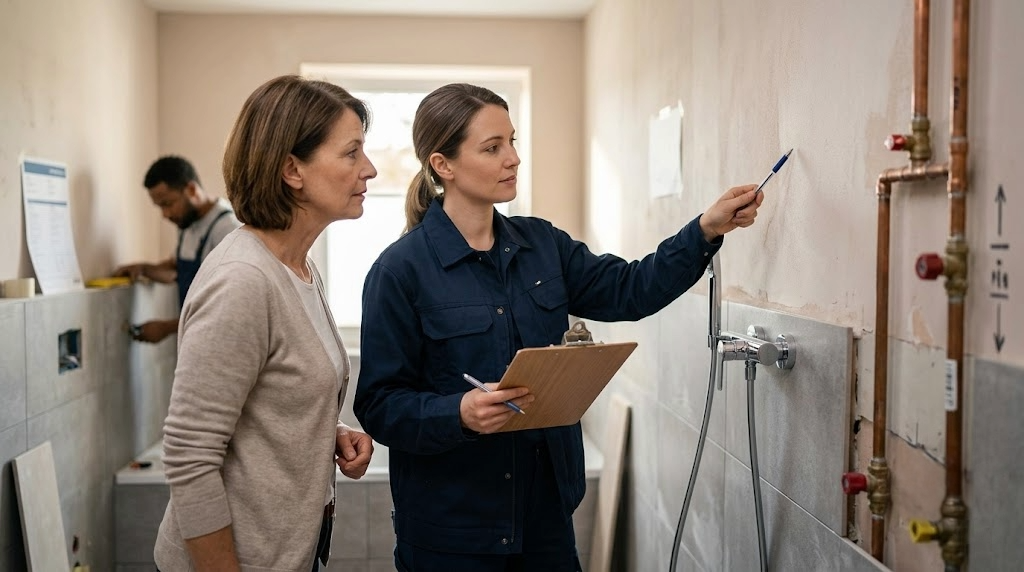
An operative, native Ukrainian speaker, is renovating a bathroom for a residential customer. The customer raises additional wishes — a towel-warmer radiator instead of the standard one, the shower fitting a floor higher, a tiled wall shelf. With Elva the installer practised customer dialogues: scoping the job, flagging a variation, discussing price. At the kitchen table she covers three variations in ten minutes and secures around €800 of additional revenue for the business — with no complaint risk.
Operative: "No problem. For the extra it comes to about €380 net. My boss will send you the exact quote tomorrow. Does that work for you?"
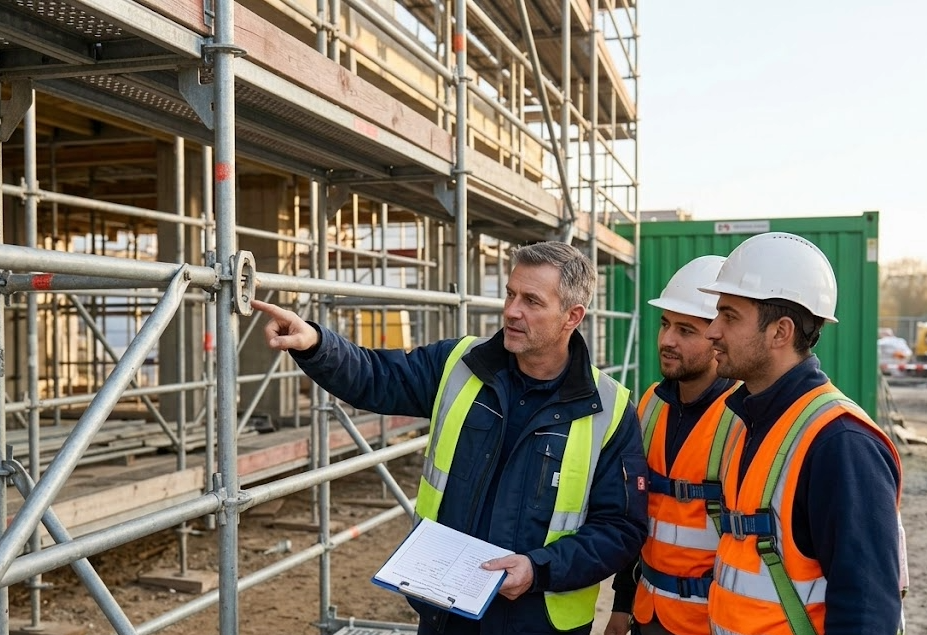
A neighbouring site had a fall. This week, this site doesn't.
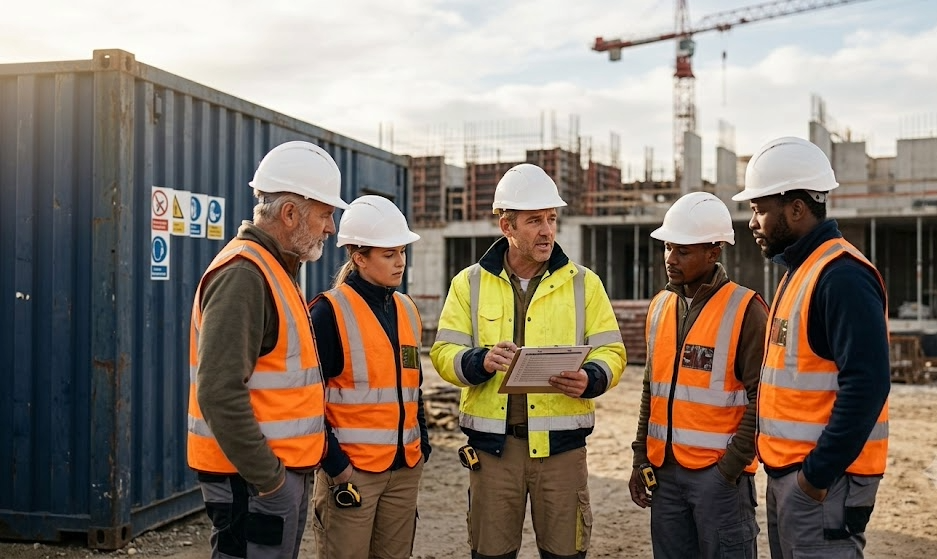
Two new operatives, native Romanian speakers, start in a week where scaffold safety is the central topic — after a fall on a neighbouring site. In their first three days at the business, they practised the modules fall protection, PPE anchor points and scaffold inspection with Elva. At the Toolbox Talk they answer the foreman's specific questions clearly. The briefing is now documentably understood — the business and its liability side are clean.
Operative: "At the marked ring at the fall edge, visually checked before every use. And signed off in the briefing log."
Foreman: "Exactly. Carry on."
One product, three perspectives.
The Coach serves every level in the business — from HR and management to the site foreman and the crew on site.
HR & Management
Language proficiency as an HR KPI. Ramp-up time down 20–30%. Safety records secured. Master-craftsman candidates retained.
- Multi-site administration (multiple sites/branches)
- Works council template included
- Reporting for management and BG BAU
- CSV export for training records
- Transparent per-seat cost
Site management, foreman & master craftsman
Less language-related friction in daily operations. Per-person progress in the dashboard — no extra load on the foreman.
- Course templates for site, fit-out, customer contact
- Business- and site-specific SOPs can be added
- Aggregated crew and gang views
- Per-person progress tracking
- Exam prep visible in the dashboard
Operatives in crafts & construction
Safe on site. Confident at the customer's door. Trade-specific vocabulary, live dialogue with Elva, visible progress up to exam readiness.
- Mobile use across sites and shifts
- Vocabulary for shell construction, fit-out & customer contact
- Live conversation with Elva, our AI trainer
- Direct feedback while practising
- Journeyman & master-craftsman exam prep
Does the Coach pay for itself? A look at what language gaps actually cost.
What language gaps typically cost in crafts and construction — and how the Coach compares.
A fall from a scaffold, a misheard crane signal, missing fall protection — the BG BAU records around 80,000 reportable construction incidents per year. A single incident costs the business downtime, rework, higher insurance premiums and reputational damage.
Customer request not clearly captured, variation not flagged, defect obscured by unclear phrasing — the business ends up with invoice write-downs, rework effort and negative online reviews.
Every operative who needs 3–4 extra weeks to reach full productivity costs the business labour and site expense at this order of magnitude — per new hire.
Practically strong candidates fail on the exam language. Lost training years, lost qualified staff — who either leave or stay in a lower-paid role.
For comparison: the per-seat licence fee is well below any single one of the risk categories above. One incident avoided, one complaint avoided, or one candidate who passes the master exam covers the investment many times over.
ROI calculation for your businessHow the pilot works — in three steps.
From the first call to the joint review: predictable, transparent, no risk.

Introduction
A 30-minute demo with an industry specialist from our team. Live dialogues from daily operations, exam prep, safety vocabulary. We assess your business-specific requirements (SOPs, operating instructions, the exam formats of your local chamber of crafts).

Set up the pilot
Course templates for your business, access for 30–80 operatives across 1–3 crews or work gangs, HR or workshop management as admin. Business operating procedures uploaded. Tags applied by site and crew.

Review the results
Evaluation: language proficiency development, crew usage, feedback from the foreman, readiness for the next master-craftsman exam. Decision on rollout to more sites or locations.
Confidence you can rely on.
Data protection, works council template, BG-BAU- and HWK-ready records, European brand.

GDPR compliant. Works council template included. Learning and language-proficiency data of your workforce stays with you.
AI processing on secure servers — no model training on your data or your workforce's data.
Training records aligned with DGUV Regulation 1 and BG-BAU inspection practice. Exam prep according to the Handwerksordnung and HWK curriculum framework.
Over 100 years of language-training expertise. Developed in Europe, backed by the PONS and Langenscheidt brands.
Frequently asked questions
The five questions HR directors, business owners, and site managers ask us most often.
Can we integrate our operating procedures and safety SOPs?
Can we document the training as a training measure under DGUV Regulation 1?
We work across changing sites. Does that fit?
How do we make sure the works council is on board?
What does it cost per business?
Book a demo — and see how the Language Coach fits your business.
In a 30-minute call we show live dialogues from daily site and customer operations, safety vocabulary and exam prep, run the ROI against your specific safety, complaint and exam metrics, and walk through the pilot scope.
